Showing posts with label macro. Show all posts

Sunday, November 25, 2012

Dust bunnies at macro level

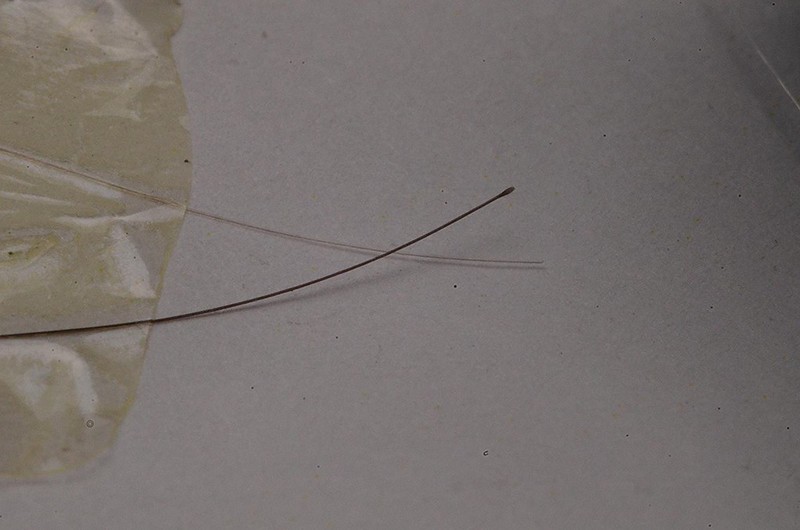
Macro shot of my hair.
Talk about dirty!  This morning while I was combing my hair, I picked out one strand of hair from my comb.  It was interesting looking because the tip of the hair was white (yeah, I have gray hair since I was 24) and the base of the hair was black!  This was a second time I saw one of these hair strands like that.  Am I getting younger???

In any case, it was interesting enough I had to take a shot of it to document the anomalous growth.  I decided to use the Nikkor 105mm lens.  I thought it could do 1:1 reproduction but for some reason I could not get really close to the hair so I added an extension tube.

What came out was a little surprising.  Yes, I got my shot to demonstrate the weird change in colour but I also got a ton of dust dunnies in the photo!  All those really dark spots in the photo are dust bunnies!  They do appear at f/32 on my 18-200mm lens but they are a lot more apparent at the macro level.  Holy molly, I initially thought they were black spots on the paper that the hair was taped on but no, those were on my sensor!  Ok, time to do another wet cleaning.

Why do I get so much dust inside my camera???

Tuesday, March 13, 2012

105mm macro

It's rare that I see a bug in my house in the middle of winter but every now and then, a tiny, bitsy household spider will creep up out from the dark hideout it lives in.  This one spider was crawling in my bathroom the other day.  I was about to leave for work but had to take a few minutes to make use of my 105mm f/2.8 AFD lens.  I was lucky enough it was already mounted on my D90.

Here, I shot it at f/32, ISO1600, with bounce flash.


Sunday, August 22, 2010

Macro with a Nikkor 105mm AF-D

I decided to bite the bullet and invested in a second hand Nikkor 105mm AF-D lens -- not the VR version. I shot some tests and it looks much more promising than my 50mm + extension tube system. What I was looking were the following:
  • Depth of field: the 50mm system gave me only about 2mm to work with. There was no way I could not capture the whole body of a bee with it. The Nikkor 105mm gives you something somewhere between 1.5mm (at maximum aperture) 10mm (at f/16) to 25+mm (at f/57 at 1:1 macro). This greater DOF will be extremely useful when shooting without (and also with) a tripod.
  • At minimum aperture, the picture in the viewfinder through the 50mm system is completely dark so it is nearly impossible to focus on the subject. It helps in bright daylight but light is not always available. With the 105mm lens, the aperture stays wide open until you release the shutter. This way, you can easily focus on the subject.
Some issues I found:
  • Not that I did not know, but things become quite jittery at macro level. Without a tripod it is hard to obtain a sharp picture unless there is a strong source of light.
  • The Auto Focus system is a bit hard to use. I use this lens with my D300 and I was trying to shoot a ruler at a 45 degree angle to gauge the DOF. The AF has no problem with hunting for a focus point 40cm away but was having some problems at really close distance. I'd be better off using manual focus in this case.
Well, I took some shots of a house fly on a flower (weird uh?) yesterday. I was quite happy with the result. I used the built-in flash for these shots (image contrast adjusted and image sharpened a tad bit in Irfanview):


Thursday, August 19, 2010

Macro with the 50mm and extension tube, part 3

A couple of macro shots of a tiny spider clinging to a wall:


DOF is really small at all f/stops!


Sunday, August 15, 2010

Macro with the 50mm and extension tube, part 2

It rained hard about an hour earlier. I thought I'd look for some insects to shoot after the rain. There were a few but only one that stayed in one place long enough for me to shoot.

I have no idea what this fellow is, but it is colorful and tiny (maybe 1cm long). Was it going to drink from the water droplet? It took me 10 shots to get its head somewhat focused. (My 50mm with the extension tube is far from the perfect macro setup, but it helps that the D300 can meter properly.)


There was a weeny tiny little larva on this flower. After the rain, the larva was crawling in very wet cracks.


The world according to a water droplet hanging off the tip of a leaf.


Sunday, July 25, 2010

Macro with the 50mm and extension tube

Alright, the excitement is fizzling. The 50mm lens with an extension tube can do macro but what I have noticed is that the depth of field is too small for anything but tiny bugs that are 2 mm long. Yes, 2 millimeter. That is not very long. That is the depth of field I have to work with at f/1.8 or f/11. Practically speaking, most insects I'd run into are significantly larger than 2 mm so I think I need a different solution for macro photography. I need a depth of field of at least 15mm.

I used to have a Vivitar 70-210mm lens. Maybe I should not have sold the lens.

First macro shot with D300

Here is the first shot I took with my D300 and the pancake 50mm MF AIS lens with an extension tube:


As one can see, about 19 mm of the ruler fits onto the sensor of the D300. Given that the D300 sensor is 23.6mm wide, the macro setup produces a 1.24:1 ratio. It is better than the 105mm macro lenses but obviously, I'd have to get pretty darn close to a subject with the 50mm, in fact, about 10 cm, a tiny bit too short for live insects.

Here is my D300 fitted with the 50mm attached to a simple extension tube. The extension tube has no electronic contacts.

Sunday, December 14, 2008

Sigma 24-70mm f/2.8 MACRO mode

The Sigma's Macro mode is ok. A real-life ratio of 1:3.8 is not bad, but remember I still have my extension tube? It was used with both the Nikkor 50mm f/1.8 and the Vivitar 70-210mm f/3.5 for macro. The results were good. Well, I decided to run a quick test with the Sigma.

I will post the images later but I could easily magnify better than real-life ratio of 1:1. It sounds really good but the lens has to get really close to the subject, and then light becomes a big issue. My hotshoe speedlight alone might not be tall enough to hit the subject, especially when this lens is 82mm on the far end. I will have to use it as a remote or get some reflectors set up.

Friday, October 31, 2008

Macro photography, part 2

Well, as you know I have bought a Sigma 24-70mm + Macro. Since I rarely shoot with my 50mm f/1.8 I have decided to let it go too. For macro photography, I think I will pleasantly be surprised with the macro capability of the Sigma lens in front of an extension tube. The Tokina 80-400mm can do wonderful macro already with the extension tube so I expect the Sigma to perform very well in macro mode.

The 50mm is on its way out. I do not miss the f/1.8 as I do not find myself using it often enough. I might pick it up again at a later time.

The wasp ... my subject. I closed my windows for a few days as the wasp refused to get out. Well, the wasp is gone ... disappeared. It is not laying dead in my window frame. It disappeared. My macro subject is gone.

Sunday, October 12, 2008

Macro photography

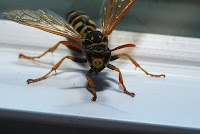
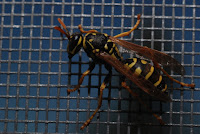
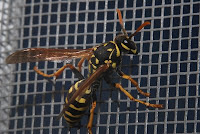
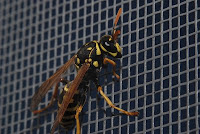
Well, I was not planning to do any shooting today although the idea of another hiking trip was very appealing in this 25C temperature, but a buzzing noise was hovering over to my right in my bedroom. The last time I heard that buzzing was from a wasp that managed its way into my room a few weeks ago. I wondered where it came from. Well, today, I see two of them. I think there is a hole in my new window frame and their nest is somewhere close, very close.

Anyways, I decided to test the macro capability of my Vivitar 70-210mm. Alone, it can produce 1:2.2 real life ratio. Added the 2x teleconverter I have, I can whip up a near real life macro shot, at 1:1.1. I took a few shots of the wasp but I had set the shutter speed too slow at 1/10 secs so the pictures turned out a little blurry. I did however get a couple of shots at 1/320 secs. I also tested my 50mm lens with one 50mm extension tube to take a few shots of the wasp.
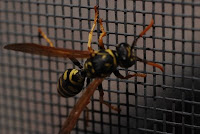
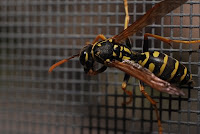
The first four shots are from the Nikkor 50mm. The last two on the right are from the Vivitar 70-210mm. The original photos have been resized to 1024x685 but they are not cropped so what we see here is what filled the sensor screen. With either lens, you have to get to about 10 cm of the subject. It was a little unnerving to get so close to a wasp (as I had been stung once) but this one was very gentle.

For these shots, I had to use the external speedlight set on Manual mode as the built-in flash is too low -- the Vivitar lens is almost a foot long. In Manual mode, the speedlight does not talk with the camera so it was a little painful trying to figure out the right setting without a light meter. I wish I had a D300 or one of the other professional DSLRs that can meter with the manual lenses. I had to take a few shots and adjusting power output level of the fash, before getting the right exposure.
The lens aperture was set between f/8 and f/22. The speedlight was set somewhere between 1/128 to 1/1 depending on the shutter speed I used.
For most of the shots at f/16 or f/22, the power output from the flash was set to 1/1. I just cannot remember which photos were shot at minimum aperture but the last two photos were shot at f/16.

So, which lens do I prefer for macro photography? I have to say, the old 1975 Vivitar lens was easier to use. At whatever aperture I dialed, you could still view the subject clearly in the viewfinder -- the Vivitar lens is a bigger, wider lens than the 50mm so at f/22 the Vivitar aperture is the same size as the Nikkor 50mm lens at f/8. That is, the Vivitar can gather a vast amount of light even at f/22. With the Nikkor 50mm, without background light, it may be impossible to see what you are shooting. So, for this reason, I prefer the Vivitar and while I had the intention to sell it because I hardly ever used it, I will keep it for macro photography now.
Potensic Atom Follow-Me Mode

The Potensic Atom's Follow-Me mode is one of its "intelligent flight" modes.  It's a really nifty feature that uses visual...