Last year, I wrote about removing a dented filter from my Nikkor 18-200mm lens (see: Photon Farmers: Stuck filter on lens.) I thought I'd write a bit about the lens after one and a half years later.
You gotta give it to Nikon. They do make a really solid lens, even if it's mostly plastic! The force of the impact from the drop dented the filter enough that its rim is warped. The filter does not thread into the lens barrel easily now, although I could still use it. Immediately after the drop, I could feel something was not right with the lens. The focus ring felt a bit gritty. Whenever I use it, it feels as if there are tiny bits of sand inside. It does not seem to affect much anything anyway so I do not care much about the gritty feel. However, there is something I noticed on one camping trip while I was shooting the stars at night. The lens used to be able to focus to infinity without a problem. My shots of the stars were all blurry. All the images were out of focus. Also, when I turn the focus ring manually, the focal length indicator inside the lens does not turn sometimes. I never had this problem before the drop so I guess there was some damage. Besides that though, everything about the lens is working fine. The VR is still working smoothly. The zooming is fine too. The lens is still my primary go-to lens. I use it for almost everything I do these days, whether it's for a party or for a hike. So, hats off to Nikon for building such a solid lens!
Showing posts with label nikkor 18-200mm. Show all posts
Showing posts with label nikkor 18-200mm. Show all posts
Saturday, October 20, 2012


Sunday, October 14, 2012
Loose lens hood
 |
| Sagged bridge on my HB-35 lens hood. |
Maybe the old adage rings true even for accessories like a lens hood. You get what you pay for. The lens hood was super cheap, shipped from China. It worked great--well, it's just a lens hood--but there was one thing that irked me for over a year now. The lens hood was a little loose. It was easy to knock it off and it's something that is constantly on my mind on hiking excursions. I remember having to deal with it in Cape Breton by inserting a strip of birch bark in between the hood and the barrel. (I did not have any plastic or paper at the time.) In contrast, the original lens hood had a tight fit and wouldn't easily get knocked off, although it is still very possible--I almost lose mine on a hiking trip in Costa Rica one year.
Today, I read somewhere someone had the idea of using tape around the barrel. I guess that could work but tape may come off and leave a gluey residue behind. Someone had melted the plastic of the hood for a better fit. So, I thought I'd try that, and above right is the result. Notice the imperfect bridge. That was my melted hood. I held a lighter under the hood at some distance but close enough to heat up the bridge where the small nodge is. It could see the plastic starting to sag a little. As soon as gravity started to bend the plastic, I remove the flame, and let the plastic cool down and harden once again. Now, I've got a really good, tight fit!
Disclaimer: If you try this, be very careful. That plastic melts really quick and can easily catch fire too! Do so at your own risk!
Saturday, July 7, 2012
Water in your lens?
I was on my fifth day of a nine-day trip in Nova Scotia when I found out in the morning that water had condensed on the inside of my Nikkor 18-200mm lens. The condensation sat on the glass elements as tiny water droplets. Through the viewfinder, it was like looking through thick fog. There was no way to shoot through it!
That was totally my fault. The day before, rain was pouring down like cats and dogs and knowing my lens was not water resistant, I still went out and took pictures in the rain. The air was moist and rain was beating on my camera body and lens. I did not care so much about the camera as the D7000 is supposed to be somewhat weather sealed. However, I did not take the same precautions I used to take with my lens. Before, I would shoot in the rain but would always have a plastic cover to protect the lens. I did not have anything this time around. So, what happened? Slowly, water got it into two chambers of the lens barrel!

I was quite mad when I realized I could no longer use the lens. I brought two others lenses along but this 18-200mm was my primary, all-purpose lens. On my drive from the Fundy National Park (in New Brunswick) to the Confederation Bridge, I started to think how I could get the moisture inside the lens out. It would be nice to have a vacuum cleaner of some sort and suck all the moisture out, but it would not be that easy anyway. Well, as luck would have it, the sky had cleared up, the sun was out, and the air was dry. Inside my car, without air circulation, it would take a minute or so to feel the temperature rise. I had an idea.
The lens can zoom in and out, so it has to draw air in and out. When the lens zooms in, the barrel extends out, air is pulled in. When the lens zooms out, the barrel retracts, and air is pushed out. I let the temperature in my car rise. It became warm and dry, perfect for drying out the inside of the lens! I simply ran the lens through a couple of dozen zooming motions. As I retracted and extended the lens barrel, I could feel and actually see moisture collecting on the outside of the barrel, drawn from inside lens. I could clearly see the condensation inside the lens thinning out slowly, so I kept on zooming in and out until the inside lens elements were clear again..
I was so relieved the lens became usable once again. A lesson learned.
Sunday, February 12, 2012
D7000 back-focus problem
 |
| Nikkor 80-200mm f/2.8 ED AF-D |
 |
| Back-focus problem of D7000 with Nikkor 80-200mm: "Hiding" is supposed to be the centre of focus. |
Sunday, August 14, 2011
Rubber zoom ring on Nikkor 18-200mm, part 2
In June 2009, after a trip to Cuba, the zoom rubber ring on the Nikkor 18-200mm got really loose. I had to cut a few millimeters off the ring and glue the ends back together with Krazy Glue. Two years later, last night, I had to do the same thing again. I had to cut another few millimeters of the ring as it got fairly loose. I must have cut about one centimeter in total so far. A few drops of the Krazy Glue did the trick as usual. The rubber ring feels tight and snug once again.
I wonder if this is a problem with the rubber rings on other lens manufacturers, or is it just because I use this lens so often in the humid and hot weather of Toronto/Cuba summer.
P.S. I had mentioned that Nikon sells a replacement rubber ring for probably $10. I thought I'd check on eBay. The ring goes for $18 USD or so.
Saturday, July 17, 2010
Missed my 18-200mm lens
I was in Vancouver for a week for a wedding last Saturday. Before the trip, I decided I was going to bring four lenses: 80-400mm, 50mm (manual focus, to play with), 17-50mm (for the wedding) and 18-200mm (attached to a D80 body, for the wedding, and for walking around with). As it turned out, my equipments could not all fit into my backpack and it was getting pretty heavy. I decided at last minute then to leave the 18-200mm with the D80 behind.
That was a mistake. I could leave the D80 behind but I really missed the 18-200mm focal length. I ended up having to switch between the 17-50mm and the 80-400mm lenses at the wedding reception (because sometimes I wanted to shoot close-up from afar), on the ferry to Vancouver island, at the top of Grouse mountain, in Victoria, etc. I also found that at the civic wedding ceremony that was held outdoors, that the 17-50mm was a bit short on the focal length side. I did not want to buzz around close to the couple like a bee during the ceremony. The 18-200mm lens would have been perfect then. Oh well. I should be better prepared next time.
That was a mistake. I could leave the D80 behind but I really missed the 18-200mm focal length. I ended up having to switch between the 17-50mm and the 80-400mm lenses at the wedding reception (because sometimes I wanted to shoot close-up from afar), on the ferry to Vancouver island, at the top of Grouse mountain, in Victoria, etc. I also found that at the civic wedding ceremony that was held outdoors, that the 17-50mm was a bit short on the focal length side. I did not want to buzz around close to the couple like a bee during the ceremony. The 18-200mm lens would have been perfect then. Oh well. I should be better prepared next time.
Monday, June 22, 2009
Rubber zoom ring on Nikkor 18-200mm
After about two years, the rubber zoom ring of my Nikkor 18-200mm VR lens showed signs of age. After Cuba, the rubber started to loosen up. It got stretched by about 3mm. I got so annoyed by the loose rubber ring. The feeling of looseness was not fitting with a camera, so I decided today to do something about it.
After playing around with it for a bit, I figured there was no glue holding it together. It was just a rubber ring. So I slid it out. What you see below is the underside of the rubber ring pulled over the extended barrel.

Here, I removed the rubber ring from the lens altogether:

I could not think of a way to compress the rubber ring so there was only one solution -- cut it (note the length of the segment was cut):

After cutting it, I wrapped the rubber "ring" around the lens and used Instant Krazy Glue to connect the two ends together. I use Krazy Glue for many things, including the Gary Fong Lightsphere imitation.

The Krazy Glue line looks like a scar but at least, the rubber ring feels good to the touch. It is tightly wound around the barrel.
Nikon sells these rings for $10 I believe.
Sunday, December 21, 2008
Nikkor 18-200mm in the Cloud Forest
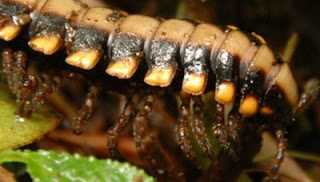
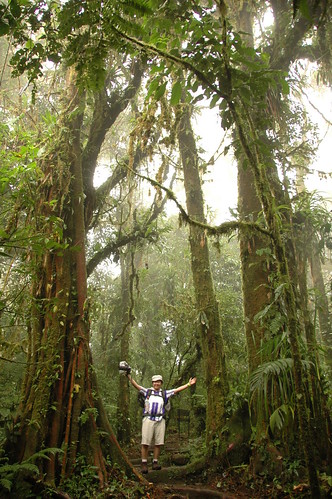
Below are a couple of pictures John shot with his D70s and my Nikkor 18-200mm in the Cloud Forest of Santa Elena. They came out quite sharp. The first was shot at 200mm f/5.6 ISO400 for 1/20 seconds. The second was shot at 18mm f/3.5 ISO400 for 1/80 seconds.
A juvenile centipede crawling on the forest floor:

A full 1:1 crop of the centipede:
 Me among the trees -- John has a good eye for composition and perspectives, and it helps that a lens can do 18mm:

A juvenile centipede crawling on the forest floor:
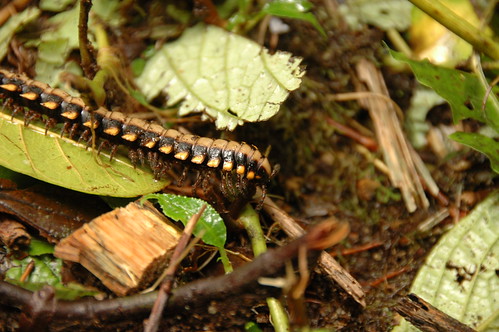
A full 1:1 crop of the centipede:
 Me among the trees -- John has a good eye for composition and perspectives, and it helps that a lens can do 18mm:
Subscribe to:
Posts (Atom)
Potensic Atom Follow-Me Mode
The Potensic Atom's Follow-Me mode is one of its "intelligent flight" modes. It's a really nifty feature that uses visual...

-
A local Zellers store is having liquidation sales of everything in the store. I was browsing through some electronics the other day--not pl...
-
So I decided that I will do an experiment. I will offer a few free photography shoots in my area for small events. I will see if the quali...
-
 I am starting to get used to shoot with a 50mm alone. For a long time, I have always trusted my Nikkor 18-200mm f/3.5-5.6 VR lens. I would...