Saturday, January 10, 2009

Holding your camera

I remember a couple of friends were shooting with their compact and DSLR cameras. Their pictures turn out a little fuzzier than I'd expect. Whether you are shooting with a compact camera or a bigger DSLR, there is a trick that can help stabilize your shots. Perhaps there is a better method but this is what I do when I point a camera at something and shoot without flash.

Here are the steps:
  1. Raise your camera to your eye level to shoot with both hands.
  2. Tuck your arms in your chest.
  3. Look through the viewfinder (or look at LCD if it's a compact camera). Think and compose your picture.
  4. Before pressing the shutter release button, take a deep breath.
  5. Exhale slowly.
  6. As you are about to finish exhaling, your body will feel calm.
  7. As you are still exhaling the last bit of breath, keep your eyes on the subject and depress the shutter release button.
  8. Hold your breath.
  9. While the shutter opens, a DSLR will blank out. This is the hardest part of holding your camera still because you cannot see what you are shooting anymore. Keep holding your breath until the shutter closes.
This method should work for shots close to one second.

Saturday, January 3, 2009

Another Step Closer

Last September, I wrote how the Nikon D90 and the Panasonic Lumix DMC-G1 were bridging the two worlds of compact point-and-shoot and the DSLR cameras. Today I stumbled upon yet another such pioneer -- the Canon PowerShot SX1 IS. This camera is not available in North America yet for some reason but its lesser sister, the PowerShot SX10 IS is.

I won't detail its features here. There are many reviews out there already. Basically however, this is one camera that I would seriously consider as a quality alternative to a low-end DSLR kit. Its 5-100mm focal length range is equivalent to 28-560mm on a 35mm. That is a wicked optical zoom factor and an awesome range. I saw some photos taken at the 100mm focal length, and with IS in bright light conditions, the photos turned out excellent, for a compact camera. Under certain conditions, it can outperform a low-end DSLR with a cheap kit lens. Check out the reviews yourself.

After reading the reviews, I started to think there is a new class of cameras: the hybrids. These hybrids are not exactly like the compact point-and-shoots. They are not really all that compact. This SX1 is rather bulky. It looks like a DSLR on the outside and is bigger than the truly compact cameras. This camera is a point-and-shoot but it has enough knobs to tweak to make it to work like a DSLR so it's not really a point-and-shoot -- and who is to say a DSLR cannot be point-and-shoot? I know some starters use their DSLR strictly as a super fancy point-and-shoot camera. I suppose we cannot use the expression "point-and-shoot" anymore to differentiate these two classes of cameras. It is not a point-and-shoot as we know it, but the SX1 is definitely not a DSLR by definition either, as it has no mirror inside. It does however have a fairly sizeable lens like those found on a DSLR although the lens is not removable. It does also have a hotshoe mount and has no perceivable shutter lag commonly problematic in many point-and-shoots.

The SX1 is a hybrid trying to define a new class as the world might consider it as an on-the-field emergency replacement for a broken DSLR, or even as a DSLR replacement for landscape and candid photography in bright daylight.

If you are an avid compact camera user who is thinking of trying a DSLR but does not want the heavy equipment and bulkiness of the DSLR, the Canon PowerShot SX1 IS is the camera for you. Wait until it arrives in North America -- don't buy its lesser sister, the PowerShot SX10 IS which goes for about $350 USD in the States. The SX1 is considerably more expensive but when it arrives (if it does), its price would have dropped significantly.

Sepia, A Warm Touch of the Old Past

A little warmer touch -- I converted the original image (see previous post) to sepia. The original bluish tone brings back memories of the bone-chilling cold night that it was. I thought this sepia image is nicer. The reddish and yellowish tone gives an image a warmer feel of the festive mood.


Thursday, January 1, 2009

Nikon D90

Well, on New Year Eve, I got to play with Jenny's D90. It was a marvel of technology. The look and feel is very similar to my D80 so I had no trouble using the camera. It felt right. Many things about the D90 are the same as the D80. However, what really stood out what the new CMOS sensor. I was astounded by the clarity of pictures taken at ISO 1600. At ISO 1600, pictures taken with the D80 look like crap -- awfully grainy to be of any use except for documentary web pictures. The D90 on the other hand captured what looked like on the big LCD very clear images with very little noise. Qualitatively, I'd say the D90's ISO 1600 is equivalent to my D80's ISO 800. There is clearly a huge gap in system performance.

Well, I hope to see some of the pictures taken last night with the D90 soon!

Happy New Year!

P.S. Despite a camera's lackluster performance in low light conditions, one has to know how to work with its limitations. As we were walking back to the parking lot, I braced myself against pole and took a shot of the CN Tower from the CBC plaza (I think that's what it's called??) with my D80.

Sunday, December 28, 2008

Resizing your photos in a batch

A friend just received a new Canon A590 IS camera. This is a nice camera with all the basic necessary functionalities of a camera to take great pictures! There is a nice review of it at the Digital Camera Resource Page.

Anyways, my friend asked me about the size of the pictures she e-mails to her daughter. They have always been awfully big. Was there something that can be done? Could there be a setting in the camera to resize the photos?

My recommendation of course was to keep the image quality to "Superfine" to capture as many details as possible and use Windows to make resized copies of the pictures.

Now, I have been using IrfanView to do quick image manipulations and resizing before posting them on websites or e-mailing them out. I was typing away some instructions when I realized that IrfanView was not the right tool. It would frustrate a non-computer user. There has to be a better (turn-key) solution. Doesn't Microsoft have some tools that can integrate into Windows Explorer?

Yes, they do. It's called the Microsoft's Image Resizer Powertoy for Windows XP. After installation, Windows Explorer will sport the option to resize an image. The software has only a few simple options -- choose the size to resize to and away it goes. A batch of picture files can be resized at once so this was the solution I gave my friend. She will be happy with this Powertoy! I know I am.

How wide are they anyways?

Seeing that the compact camera Canon SD110 was able to shoot at f/2.8 at 5mm, I started to wonder how wide 5mm on a compact really translates to. I cannot imagine how wide the field of view would be through a 5mm SLR lens. So, here is a quick test.

From one place, I shot my window frame. It is clear that the SLR lens at 18mm captures a wider field of view. At the shortest focal length, the 5mm of the tiny lens of the Canon is equivalent to about 24mm or 28mm on an SLR lens.

Canon SD110 at 5mm:


Nikkor 18-200mm at 18mm:


BTW, I did not know how to expose the shot for the outside with the Canon SD110 so I underexposed the shot manually by 2 f-stops to get the blue of the sky. Also, at an equivalent 24mm, the Canon SD110 can shoot at f/2.8 (see the previous post). That is faster than the Nikkor 18-200 f/3.5-5.6 !! :)

As a side note, if you wanted to shoot the window frame with the blue of the sky, underexpose the shot as I have done and turn on flash. In effect, you are exposing for the sky and use the flash to fill in the foreground. This is from the Canon test shots:

Always have a camera on you

There are days I feel my D80 would be an encumbrance to carry around. On a night into the city for example, I would have more fun if I didn't have to worry about a camera. You should always bring a camera though.

Last night, I left my D80 at home and brought my old Canon SD110 along. The SD110 is a neat camera that fits into a small Lowepro pouch. Use it without flash and some results can be surprisingly good -- the truth though is, I never knew how to use it properly in the past until I started playing with the D80. I have always used it the way it was marketed -- point and shoot. The camera will figure out everything for you -- almost everything.

So here were a couple of shots I took. The shot outside the bar was untouched. It was fairly sharp (and this was handheld) and a bit noisy, but it turned out quite colourful. The shot was taken in auto mode at 5mm f/2.8 at 1/8 seconds. ISO was auto -- no idea what was actually used.

This bar (not the Rhino lounge above) was quite dark. The original shot was darker than what is shown -- I increased the Gamma values and the contrast a bit. I should have overexposed the shot but being that it is a compact camera, its manual settings were not as easy to change and so I did not even think of overexposing the shot then. The shot was taken at 5mm f/2.8 at 1/8 seconds. It would appear then this was the limit of the camera. It increased the aperture to the maximum at f/2.8 and the best it can shoot at was 1/8 seconds.

The bike shot, well, is a little washed out. It had to be taken with flash, but the point was, I would not have been able to capture anything had I left both cameras home. That bike didn't need a chain. It was entombed in snow and ice!

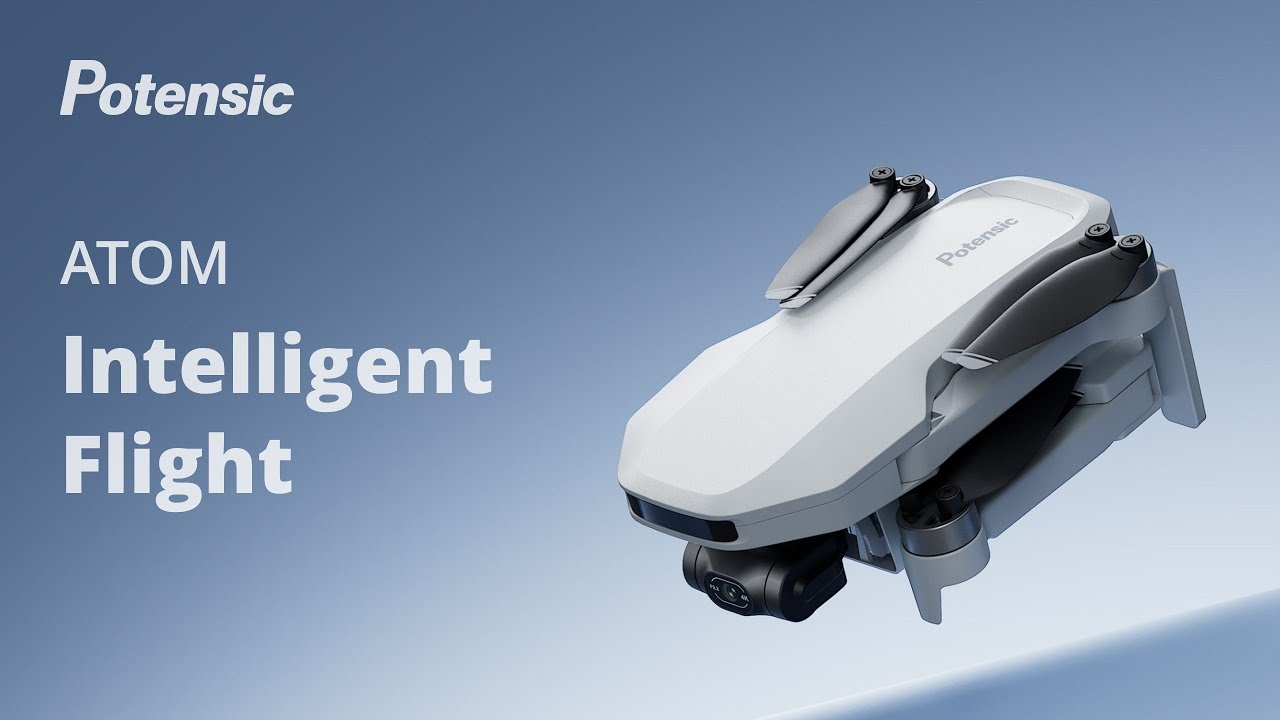
Potensic Atom Follow-Me Mode

The Potensic Atom's Follow-Me mode is one of its "intelligent flight" modes.  It's a really nifty feature that uses visual...